-
Montenegro +382 68 584 699
-
Germany +49 162 874 2423
-
Slovenia +381 611 985 908
-
Serbia, Croatia, Bosnia and Herzegovina +381 611 985 908
How to Understand Whether You Really Need a Solar Power Plant — and Which Type (Grid-Tied or Off-Grid)?
A Practical Guide for Balkan Residents, Taking into Account the Real State of the Grids and Practical Experience
Table of Contents
- Introduction: Why Has the Choice Become More Difficult in 2026?
- Part 1. Checklist: 7 Signs That a Solar Power Plant Is Your Solution
- Part 2. Grid-Tied, Off-Grid or Hybrid: What to Choose in the Realities of 2026?
- Part 3. Balkan Specifics: Grids, Tariffs and Government Plans
- Part 4. Practical Selection Algorithm
- Conclusion: The Sun Is Your Most Reliable Partner
Introduction: Why Has the Choice Become More Difficult in 2026?
If you live in Montenegro or Serbia, you have already heard about the “green boom”. Solar panels on rooftops have become a familiar sight from Bar to Belgrade. But along with popularity came new questions: will the local grid handle my power plant?, why does the inverter keep shutting down in summer?, is it worth selling surplus energy if the buyback tariff is twice as low as the retail price?
The company Topla Kuća encounters these questions daily. In this article, we will not simply list the types of power plants, but will show how to choose equipment taking into account the real state of the grids in the Balkans and the latest changes in legislation.
Part 1. Checklist: 7 Signs That a Solar Power Plant Is Your Solution
Check the applicable items. The system instantly calculates the optimal type of power plant for your conditions.
Result:
- 5–7 “yes” — a solar power plant is definitely what you need.
- 3–4 “yes” — a hybrid solution with a backup reserve will be optimal.
- 1–2 “yes” — start with an energy audit and connection point analysis.
Part 2. Grid-Tied, Off-Grid or Hybrid: What to Choose in the Realities of 2026?
Grid-Tied (On-Grid) Power Plant
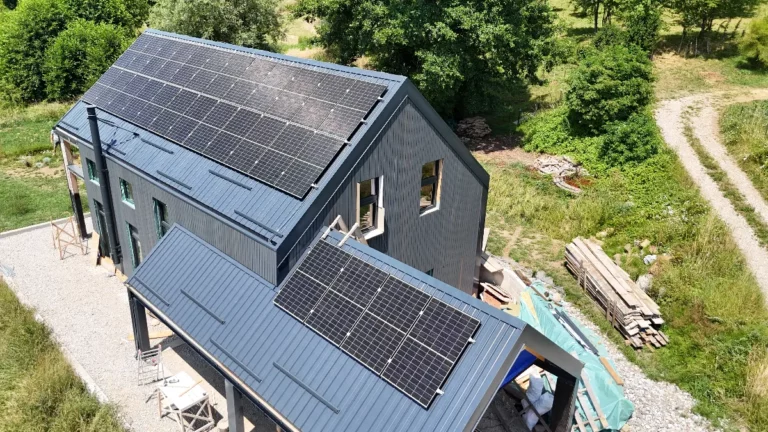
How it works: Panels → inverter → your network + the general power grid. Surplus goes into the grid, shortfall is taken from the grid.
Плюсы:
- Lower initial cost (no batteries required)
- Ability to sell surplus at the “green” tariff
- Simpler to maintain
Reality of 2026:
In the coastal areas of Montenegro and rural areas of Serbia, the grids often cannot withstand the simultaneous operation of hundreds of air conditioners and the reverse flow from solar power plants. Inverters automatically shut down when the frequency or voltage deviates. When the central grid is disconnected, the power plant also goes dark (a safety requirement). In Serbia, a limit of 6.9 kW has been introduced for households, and applications for 10.8–50 kW are temporarily suspended due to saturation of distribution lines.
Who it suits:
- Urban residents with a stable grid (Podgorica, Belgrade, Novi Sad)
- Those who want to reduce their electricity bill but are not ready for large investments
- Businesses with a daytime consumption peak and stable connection
Off-Grid Power Plant
How it works: Panels → charge controller → batteries → inverter → your network. Full independence from the external grid.
Advantages:
- Full energy independence — you have power even during grid outages
- Ideal for remote locations
- Predictable costs for decades to come
Disadvantages:
- Higher initial cost (batteries — up to 40% of the budget)
- Requires calculation of consumption and reserve for cloudy days
Who it suits:
- Owners of houses in areas with frequent outages
- Those building an eco-home from scratch
- Relocators who value control over infrastructure
Hybrid Power Plant — The Golden Mean of 2026
Combines the advantages of both types: works with the grid, but has batteries for backup. When the grid is disconnected or the voltage is unstable, it automatically switches to off-grid mode. Surplus can be stored rather than sent to an overloaded grid where it is bought back at ~5 cents when the retail price is ~11 cents.
Who it suits:
- Residents of Bar, Budva, Kotor and other areas with summer grid overloads
- Those who want both savings and insurance against outages
- Business owners where equipment downtime costs more than the batteries
Part 3. Balkan Specifics: Grids, Tariffs and Government Plans
State of the Grids: What Operators and Owners Say
CEDIS (Montenegro) officially acknowledged that the distribution system is “under great pressure due to the growing number of connection applications”. Power plant owners in Bar report regular inverter shutdowns in July–August, when the grid cannot cope with the reverse power flow. In Serbia, operators are temporarily restricting connections above 6.9 kW for private homes, citing the need to protect system stability.
What Do the Authorities Plan?
- Montenegro: An EBRD loan of €35 million for the digitisation of grids, installation of smart meters and completion of the 400 kV “ring” to relieve overloads on the coast. An underwater cable to Italy (600 MW) is already operational and stabilises energy exchange.
- Serbia: EMS announced the integration of up to 12 GW of RES by 2032, but only after strengthening the transmission capacity of the lines. Negotiations with the EU and EBRD on the modernisation of distribution networks are already underway.
💡 What does this mean for you?
Modernisation is underway, but not instantaneous. In the next 2–4 years, overloads in tourist and border areas will remain. Therefore, sizing the power plant to meet actual daytime consumption — not the roof area — and considering hybrid schemes with batteries is the most sensible step.
Economics and Incentives
- In Montenegro, VAT on solar equipment has been reduced to 7%, and the connection procedure has been simplified for plants up to 1000 kW.
- In Serbia, prosumer support programmes are in place, but with strict power limits.
- Payback period for a grid-tied plant: 5–7 years; hybrid: 7–9 years; off-grid: 8–10 years. After payback, you receive practically free energy for 15+ years.
Part 4. Practical Selection Algorithm
- Order a comprehensive audit — a Topla Kuća specialist will check not only your consumption, but also the state of the transformer substation in your area, the risk of overloads and the technical conditions for connection.
- Determine the budget and type of system — from 1000 €/kW turnkey for basic solutions. In areas with an unstable grid, we recommend budgeting for batteries from the outset.
- Choose capacity based on actual consumption — do not chase maximum roof coverage. Surplus that the grid will not accept will not generate income.
- Check incentives and limits — the reduced VAT of 7% in Montenegro applies to purchase and installation. In Serbia, take into account the 6.9 kW limit for private homes.
- Plan for maintenance — panels need cleaning 1–2 times a year; the inverter and batteries need checking every 1–2 years. We handle this under contract.
Conclusion: The Sun Is Your Most Reliable Partner
Regardless of whether you are a native of Kotor or a new resident of Budva, a solar power plant is not just technology. It is:
- Freedom from rising tariffs
- Confidence in tomorrow, even when the grid fails
- A contribution to the clean nature of the Balkans
The team at Topla Kuća helps clients make informed decisions: we analyse the state of the grids in your location, select the optimal configuration (grid-tied, hybrid or off-grid) and guarantee the correct operation of the system in real Balkan conditions.
🌞 Ready to take the step towards energy independence?
→ Calculate the potential benefit using our solar power plant calculator
→ Ask an engineer: WhatsApp chat / +382 68 584 699 / [email protected]
→ Browse completed projects in our gallery
Topla Kuća. The warmth of your home is our concern.
Article prepared with the participation of Topla Kuća experts. Information is current as of June 2026. Before making a decision, we recommend an individual technical assessment of the location and connection point.