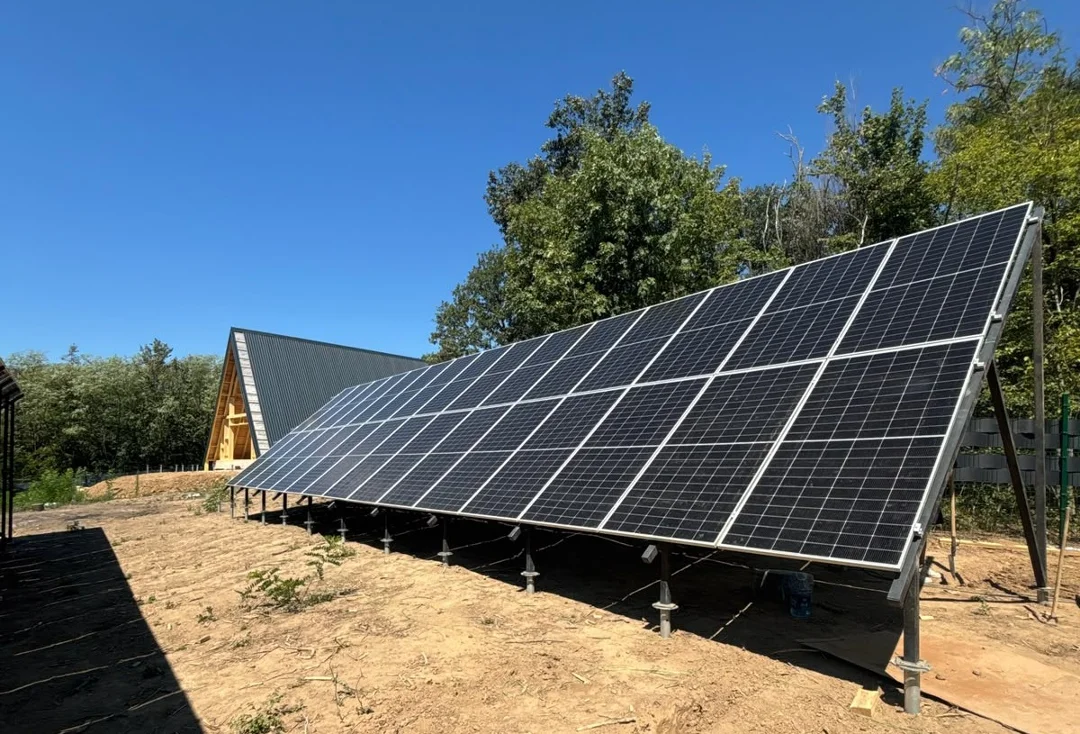

A house in Šumadija with its own power plant: 36 kW of panels and 61.4 kWh of batteries
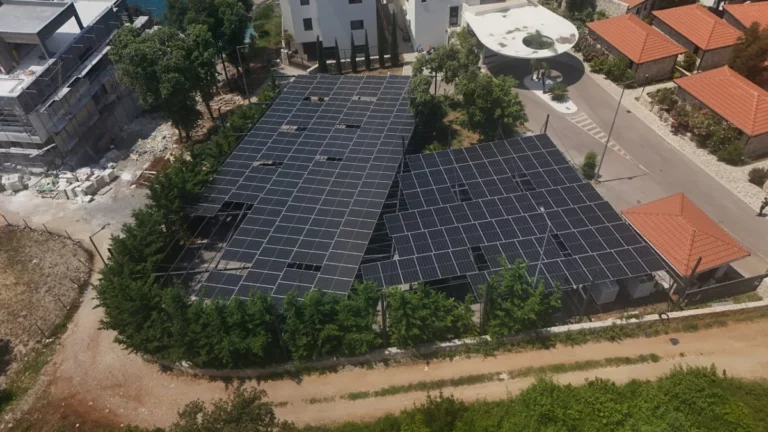
72 panels on two ground-mounted structures, designed to the Serbian SRPS EN standards. The equipment is housed in a separate insulated technical house.36 kW power · 61.4 kWh storage · 41° south-facing tilt · 25 years design life of the structure
Project figures
| 36 kW | peak power of the solar array |
| 72 panels | AIKO Neostar 2S+ 500 W, 22.4% efficiency |
| 61.4 kWh | LiFePO4 battery capacity |
| 30 kW | three-phase hybrid inverter Deye |
| 2 structures | 36 panels each, 13 trusses each |
| 48 m² | envelope area of the technical house |


The house stands by the forest, and the grid cannot handle the load
The site is in Šumadija, central Serbia, 200–250 metres above sea level. Hilly terrain, buildings and tall trees nearby, and no free space on the roof.
Saving on bills came second for the customer. The priority was that the appliances in the house would not depend on grid quality, with enough stored energy for the evening, the night and two cloudy days in a row.
Three conditions from the customer:
- Put the panels on the ground, do not touch the roof.
- Move the equipment out of the house: nobody needs noise and heat in living rooms.
- Calculate the structure for the snow and wind of Šumadija before the crew arrives, with the calculation in hand.
Result: 36 kW by day and 61.4 kWh in reserve for the evening and night
The plant covers the daily consumption of the house and keeps it running through voltage dips and grid outages. The batteries are enough for the evening peak and a whole night without a single kilowatt from the grid. The hybrid inverter distributes energy between the house, the batteries and the grid by itself — there is no need to intervene.
What this means in practice:
- The pump, boiler and air conditioners start from the batteries: the three-phase inverter handles starting currents of up to twice its rated power for 10 seconds.
- When the grid fails, the inverter switches to the batteries automatically and the appliances in the house keep working.
- Generation, battery charge and consumption can be seen in the phone app.
Solar array: 72 AIKO panels at a 41° tilt, facing due south
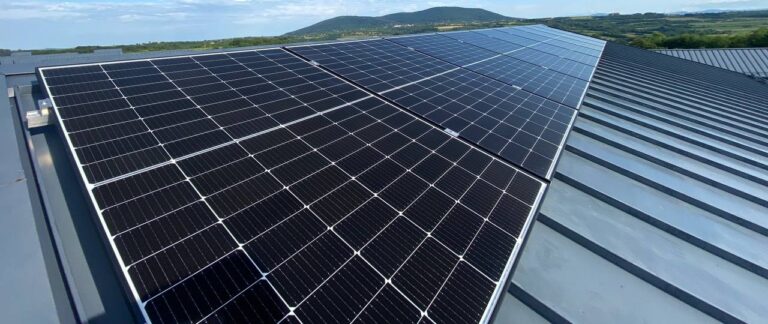
The panels are all black, AIKO Neostar 2S+ rated 500 W, 22.4% efficiency. A typical module of the same size delivers 19–20%, so from the same area AIKO produces about 12% more energy.
- Two-row portrait layout, fixed 41° tilt.
- Manufacturer warranty — 15 years, design service life — 30 years.
- Aluminium rails and AR2 clamps with stainless steel fasteners.
The 41° angle was chosen for winter output and snow shedding. At this tilt the snow slides off by itself, and the panel does not sit idle under a crust until the thaw.
Load-bearing structures: steel trusses designed for 1.0 kN/m² of snow and 25 m/s wind
Two independent structures of 36 panels each, with 13 trusses in each. All load-bearing elements are made from a single profile, SHS 60×60×2 mm, S235 steel: fewer items to purchase and fewer chances of mixing up a part during assembly.
What the calculation covers:
- Snow load — zone I, sk = 1.0 kN/m², surface load 0.4 kN/m².
- Wind load — basic speed 25 m/s, peak pressure 0.65 kN/m².
- Terrain category II–III: hilly terrain with buildings nearby.
- Design service life of the structure — 25 years.
The total weight of one structure with panels is about 1,924 kg, of which 772 kg is steel. All of it stands on screw piles: no concrete was poured, the site was not concreted, and the land can be returned to its original state.
All load combinations were calculated to the Serbian national standards SRPS EN 1991. A structural engineering report was issued for the project — the customer received a copy.


Energy center: a 30 kW Deye inverter and 12 batteries in one rack
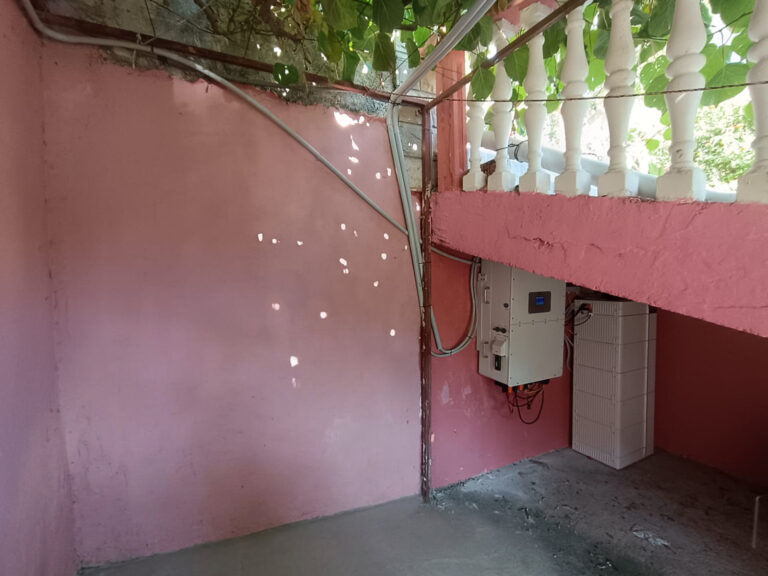
The plant is managed by a three-phase hybrid inverter Deye SUN-30K-SG01HP3-EU-BM3.
- 97.6% efficiency and 99.9% MPPT efficiency: less than 3% of generation is lost in conversion.
- Two MPPT trackers: the panels can be split between different structures without losing output.
- Passive cooling, noise below 30 dB — quieter than a refrigerator.
- Operating range from −40 to +60 °C.
- Built-in protection: against lightning, islanding, short circuit and overvoltage, plus insulation resistance monitoring.
The storage (battery bank) — 12 Deye BOS-G Pro modules of 5.12 kWh each, a high-voltage assembly through the HVB750V/100A control unit.
- LiFePO4 chemistry: the thermal runaway threshold is higher than for lithium-cobalt cells, and degradation is slower.
- Service life — at least 6,000 cycles at 95% depth of discharge. That is more than 16 years of daily cycling.
- Battery warranty — 10 years.
Technical house: the batteries work at their own temperature all year round
A separate insulated technical house on a metal frame was built for the inverter and batteries.
Why it is needed:
- Temperature. LiFePO4 charges only at positive temperatures and ages faster in the heat. 50 mm XPS in the floor, 20 mm in the walls and a vapor barrier around the whole perimeter keep the working range in both January and August.
- Moisture. EPDM tape and the vapor barrier keep condensation away from the electronics.
- Maintenance. The equipment is arranged on one wall and the battery rack stands on wheels — taking readings or replacing a module takes a few minutes, without dismantling the neighbouring ones.
- Quiet. The ventilation and the inverter hum inside the technical house, and the sound does not reach the living rooms.
What is inside:
- A frame made of 60×60×3 mm profile on screw piles, clad in 30 mm sandwich panel.
- An insulated door of 0.9 × 1.88 m and a window.
- Two forced ventilation units, LED lighting, socket groups.
- An electrical panel with a three-pole 50 A circuit breaker and protective breakers on the lines.
System composition
| Item | Model | Qty |
|---|---|---|
| Solar panels | AIKO Neostar 2S+ 500 W, full black | 72 pcs |
| Hybrid inverter | Deye SUN-30K-SG01HP3-EU-BM3, 30 kW, three-phase | 1 pc |
| Batteries | Deye BOS-G Pro 5.12 kWh HV, LiFePO4 | 12 pcs |
| Battery control unit | Deye HVB750V / 100A-EU | 1 pc |
| Mounting | Aluminium rails and AR2 clamps | set |
| Load-bearing structure | S235 steel, SHS 60×60×2 mm | 2 structures |
| Technical house | Metal frame, 30 mm sandwich panel, XPS insulation | 1 pc |
Stages: from calculation to launch
- Calculation and design. We calculate consumption, select power and capacity, and issue a structural engineering report with the loads.
- Foundations and steel. We drive the piles, assemble and paint the trusses, and erect the structures.
- Technical house. We assemble the frame, clad it, insulate it and run the electrics.
- Plant installation. We mount the panels, pull the cable, and install the inverter and batteries.
- Commissioning. We program the inverter and current sensors, connect monitoring and run a test start.
How much a project like this costs
- A 36 kW solar plant with 61.4 kWh of storage and ground-mounted structures — from €41,000 incl. VAT.
- An insulated technical house for the equipment — from €11,900 incl. VAT.
The price includes equipment, steel, installation, electrical work, commissioning and monitoring setup.
The project price depends on the terrain of the site, the length of the cable routes and the consumption of the house. Send us your electricity bill and the site coordinates, and we will come back with a calculation.
Warranties
- 15 years — warranty on the solar panels, service life 30 years.
- 10 years — warranty on the batteries, service life of 6,000+ cycles.
- 25 years — design service life of the steel structure.
- Certificates — IEC 62619, UL1973, UN38.3, VDE-AR-N 4105, IEC 62109.
Let us calculate a power plant for your home
Tell us how much you pay for electricity and what the site looks like. We will send a calculation of the power, battery capacity and cost — no obligations.
We do a limited number of installations per month in the season — send your bill today and book the installation for this month.